A homemade path game begins with a start, a finish, and a way to move between them. That modest structure leaves room for a child to invent a setting, make rules, and discover what happens when the rules are used by someone else. Counting becomes useful because a player needs to move a marker. Writing becomes useful because another player needs to understand an instruction. The first game does not need to look polished. A sheet of paper and a few age appropriate materials can reveal more about a design than a long preparation session. Keep the project small enough that you can play it before everyone loses interest.
Begin with a game that can finish
Draw a short path of clearly separated spaces. Ten to twenty spaces is a manageable starting range for many simple family games, but choose according to the child's interest and experience. There is no required number. A winding path may look exciting, yet too many spaces can create a long game with little to do. Leave enough room for markers to sit without covering several spaces at once.
Choose a familiar journey as the setting: delivering a parcel, reaching a picnic, or helping an imaginary animal find its home. Avoid making the story so complicated that it obscures the movement rule. Invite the child to name the start and finish. If decorating is their main interest, enjoy that part while keeping the playable path visible. A game can be both attractive and readable without requiring elaborate artwork.
Choose safe, easy to distinguish markers
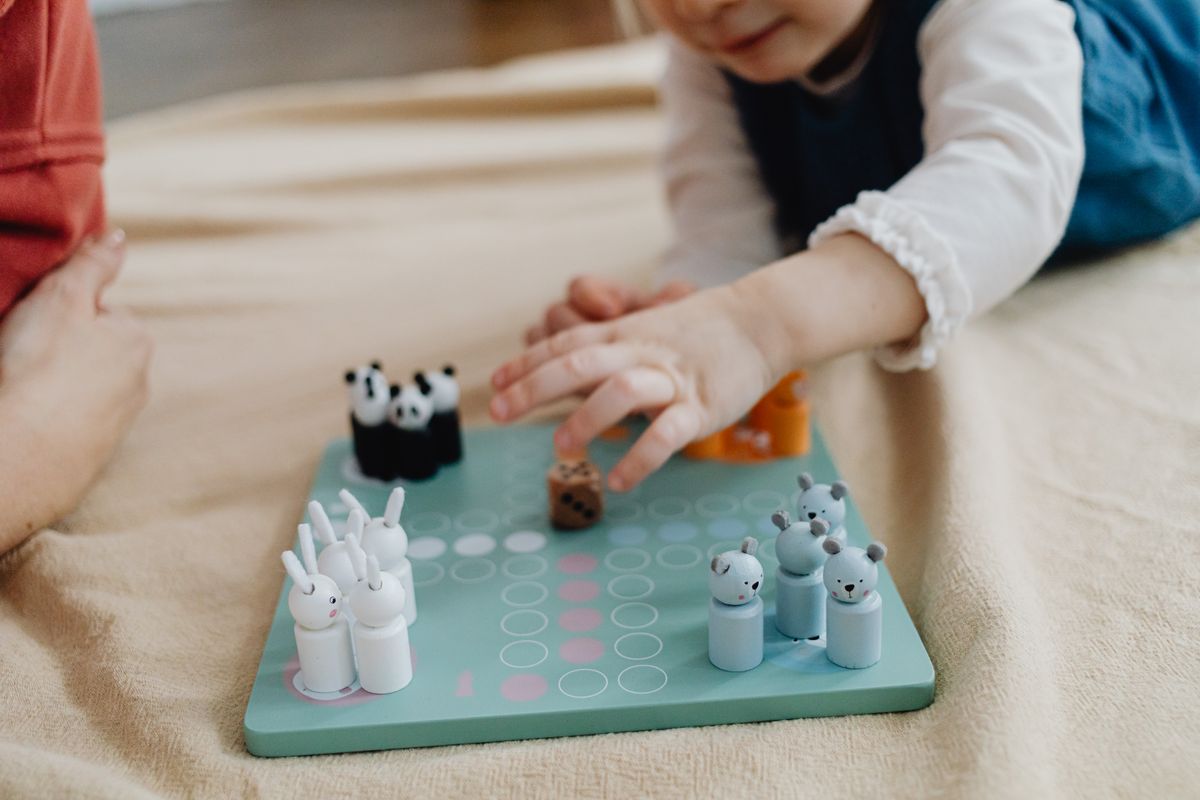
Use large counters or other suitable objects that are safe for all children who may access them. Small coins, buttons, and loose parts can be choking hazards and are unnecessary around younger children. Paper markers can work if they are sturdy enough to move. Make each player's marker distinct by shape or pattern as well as color where possible, so players do not have to rely on color alone.
Check that the movement method matches the player's counting experience. A standard die may work, but a set of cards marked one, two, and three creates shorter moves. An adult can help make a simple spinner if the materials are safe. Do not add a complex random system merely because commercial games use one. The best choice is the one players can understand and operate without repeated adult correction.
Agree on the first rule in plain language
State one movement rule: take a card, then move that many spaces. Demonstrate where counting begins. Children sometimes count the space their marker already occupies as the first move, which leads to confusion. Show one example slowly and invite a player to try. Use the same rule consistently during the first round so players can understand the relationship between the card and movement.
Decide what happens near the finish. Does any number large enough reach the end, or must a player land exactly? Either can work, but exact landing may prolong a short game unexpectedly. Choose deliberately and write the rule in a sentence or picture. A child should not discover at the last moment that the adult has assumed a different ending. Clear small rules prevent many arguments that look like difficulty taking turns.
Test before adding special spaces
Play a brief round with only the basic movement rule. Notice whether the path is easy to follow, whether markers fit, and whether players know whose turn comes next. These practical issues matter more than adding exciting effects. If the path crosses itself, use arrows or redraw the crossing. If a player repeatedly misses a space, increase spacing rather than treating every mistake as a counting failure.
Invite the child to observe as a designer. Ask, "Was there a place where we did not know what to do?" rather than "Did you make a good game?" A specific answer can lead to a useful revision. Change one feature and try again. The child may discover that a larger finish or a clearer turn marker improves the experience more than another decoration. Good design often comes from making an ordinary action easier.
Add one kind of surprise
Once the basic game works, choose one special rule. A few spaces might let players move forward one extra step, exchange a friendly message, or pick a short story prompt. Avoid covering the board with different symbols and exceptions. Too many rules make it difficult to know whether a frustrating round comes from chance, unclear instructions, or an unbalanced design.
Discuss whether a surprise feels enjoyable to the people playing. Repeatedly sending someone back to the start can make a short game drag on, especially for a young child. That does not mean all setbacks must disappear. It means their effect should be considered. A missed bonus may provide enough uncertainty without removing several turns of progress. Let the child test their idea rather than accepting an adult claim that one rule is always best.
Keep winning separate from designing
The designer may feel that losing proves the game is poor, while another player may suspect that every rule change favors its creator. Agree that rules stay the same during a round unless everyone consents to pause and revise. Write possible improvements on another piece of paper and test them in the next round. This gives the designer room to change ideas without making the current game unpredictable.
Try a cooperative version if competition overshadows the activity. Players can move separate markers toward a shared picnic or take turns moving one team marker. Give the group a clear shared goal that does not require a harsh time limit. Cooperation is a design choice, not a consolation for someone who lost. Different formats create different experiences, and comparing them can be an interesting part of the project.
Make instructions for a new player
Ask someone who did not help design the game to read or hear the instructions. The child can demonstrate, but avoid filling every gap immediately. Notice where the new player needs clarification. A rule obvious to the maker may not be obvious to someone else. Add a diagram, an example move, or a clearer sentence where needed. This is a practical reason to think about another person's perspective.
Keep the final instruction card short: the aim, the turn sequence, any special space, and the ending. For a child who does not write independently, take dictation and let them add symbols. Read the result together to check it says what they intend. A homemade game does not need professional packaging. It needs enough information that the family can return to it without reconstructing every decision from memory.
Before storing the game, count its parts together and write the small total inside the container. This gives players a quick way to check that everything is present next time. Use pictures if numbers are not yet useful for the child. A missing marker is easier to replace when the maker knows what belongs in the set, and the check connects counting with another practical purpose beyond moving around the board.
Save the version that is worth playing again
Date the board or label it as a first or second version if the child enjoys tracking changes. Store the movement cards and markers with it in a safe, suitable container. Take a photograph before a heavily used paper board becomes worn. You can make a sturdier copy later if the game remains popular, but there is no need to laminate every experiment.
Ask what the child would keep and what they would change next time. Their answer may concern the story, the size of a space, or how long a round lasts. Those are all useful design observations. The result is more than a counting exercise disguised as entertainment. It is a playable object whose maker has made decisions, considered other players, and revised an idea after seeing it in use.