A child agrees to set the table, carries two spoons, gets distracted, and returns to find an adult has finished everything. The task is technically complete, but the child has had little opportunity to become responsible for it. Handing over household work takes more than assigning a job. It involves choosing a task the child can manage, showing what finished means, and tolerating a reasonable difference between a learner's result and an adult's preferred method. The aim is a real contribution that belongs to the child. Start with something small enough to teach patiently and useful enough that the family can notice its effect.
Match the task to the actual child
Age labels offer only a rough starting point. Consider reach, strength, attention, sensory preferences, and previous experience. Carrying a light laundry basket may suit one child but be awkward for another. Sorting cloth napkins, putting unbreakable cups out, or returning books to a low shelf can all be meaningful work. Avoid tasks involving sharp tools, hazardous products, heat, heavy loads, or other risks beyond the child's readiness and supervision.
Choose a job that occurs regularly enough to practice. An occasional complicated project may be enjoyable, but repetition makes a routine easier to learn. Explain why the task matters in everyday terms: "When the cups are ready, we can all sit down together." Do not claim that one small job will transform character or guarantee independence. It is useful because it helps the household and creates an opportunity to learn a particular sequence.
Set up tools before giving instructions
Make the necessary items accessible. A child cannot put away towels if the cupboard is too high or clear a place setting if the stack is too heavy. Reduce the task to what can be done safely. Store a few lightweight items at a reachable level, provide a stable working surface, and remove avoidable obstacles. If an adult must unlock a cupboard each time, decide how the child should request access.
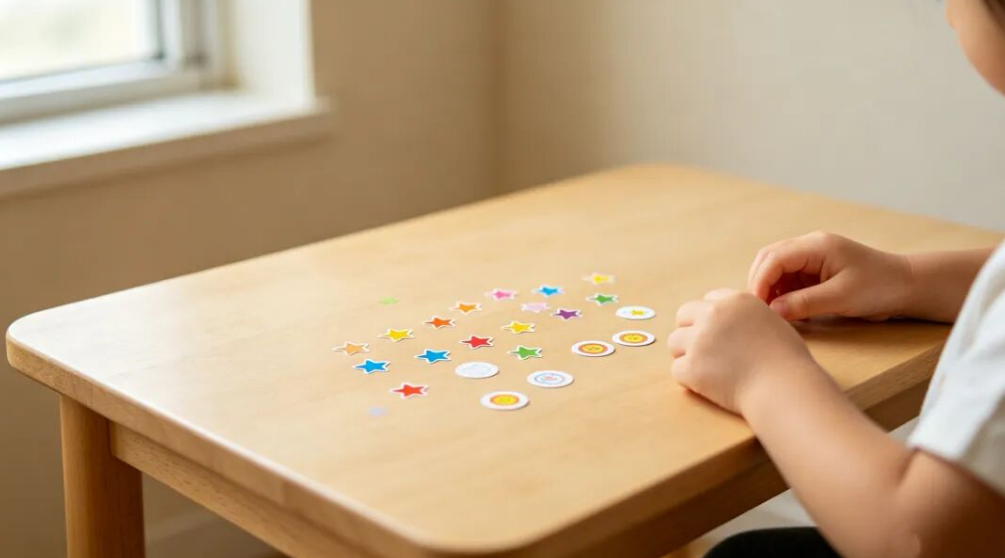
Keep supplies consistent while the routine is new. Changing the storage location or equipment creates an additional problem the child may not know how to solve. A simple picture of the finished arrangement can be helpful. Put it where the task happens. Avoid a large chart of many jobs when only one is being learned. The environment should carry part of the reminder so the child does not depend entirely on repeated adult prompts.
Demonstrate the whole sequence once
Choose a calm moment to show the job slowly. Describe the important actions and safety points without adding a long lecture. For table setting, you might demonstrate carrying one item at a time, choosing the right number of places, and leaving space at the edge. Then invite the child to try while you remain available. Do not expect them to remember a long verbal list delivered from across the room.
Ask the child to show what comes next rather than testing whether they can repeat the instructions word for word. If a step is missed, point to the relevant item or picture. A short cue such as "Look at each place" can be enough. Repeating the entire sequence after every mistake may make the task feel more complicated than it is. Teach the step that needs attention and let the child continue with the parts they know.
Define a reasonable finish
Separate what is necessary from what is simply your preference. Cups need to be stable and clean; they may not need to match. Towels should be dry and in the right cupboard; their folds do not have to resemble a display. If a particular arrangement genuinely matters, explain it before the work begins. Hidden standards create frustration because the learner cannot know when the job is complete.
Give the child a quick way to check their own work. Count the people and compare that number with the cups. Look for laundry still outside the basket. Check that the shelf is clear of the doorway. This is more useful than waiting for an adult inspection of every detail. When the result is safe and functional, accept it. Quietly redoing the whole job can communicate that the child's contribution never quite counts.
Help with the obstacle, not the entire task
When a child gets stuck, ask what is making the next step difficult. They may not know where something belongs, may be unable to open a container, or may have forgotten the sequence. Offer the smallest help that allows them to continue. Open the stiff lid, carry the heavy part, or point to the next picture. Leave the remaining work with the child when that is realistic.
There will be rushed days when an adult must finish. Say so directly instead of turning the situation into a moral lesson. "We need to leave now, so I will finish this part today" preserves the distinction between a timing problem and a judgment about capability. Return to practice on a calmer occasion. A job does not have to be completed independently every time for the gradual handover to be worthwhile.
Use reminders that can eventually fade
Agree when the task happens: after breakfast, before dinner, or when the clean laundry arrives. A connection to an existing event is often easier to remember than a time on the clock. Begin with a nearby reminder, then step back as the sequence becomes familiar. If forgetting continues, reconsider whether the cue is visible and whether the timing fits the household's real routine.
Avoid reminders framed as predictions of failure. "You will forget again" adds pressure without giving useful information. A neutral cue points to the action: "The clean towels are ready." Thank the child for the concrete contribution rather than labeling them as the family helper or comparing them with siblings. Other children should also have opportunities to contribute in ways that suit their abilities. Fairness does not require identical jobs or identical speed.
Teach the recovery step too
Ordinary work includes small mistakes. Show what to do when a clean napkin falls, a cup is placed at the wrong seat, or a book goes onto the wrong shelf. Keep safety first and choose recovery actions the child can manage. A dropped breakable item, for example, needs adult handling rather than an instruction to clean up independently. For a harmless mix up, invite the child to identify the next useful action. This makes the task less fragile: one error no longer means the adult must take everything back. Knowing how to recover is part of ownership. It also gives the adult a reason to remain calm, because the routine already includes a way to put an ordinary mistake right.
Review the handover together
After several attempts, ask which part feels easy and which still needs support. A child may suggest a storage change that makes the routine work better for everyone. Keep the task stable long enough to become familiar before adding several new responsibilities. If the job remains a constant struggle, choose a smaller version or a different contribution. Persistence is useful only when the task and support are reasonably matched.
The adult's role gradually changes from doing, to demonstrating, to answering an occasional question. That transition is rarely perfectly smooth. Expect uneven days and let the child's competence be visible in ordinary life. A table ready for dinner or a basket of folded cloths is a modest result, but it is real. The child has helped the household function, and the work has remained theirs long enough for learning to take place.